
Page last updated on July 20, 2026 at 1:57 pm
The seasonal Parklet Program allows the use of parking spaces to expand dining outside the participating businesses in the downtown area.
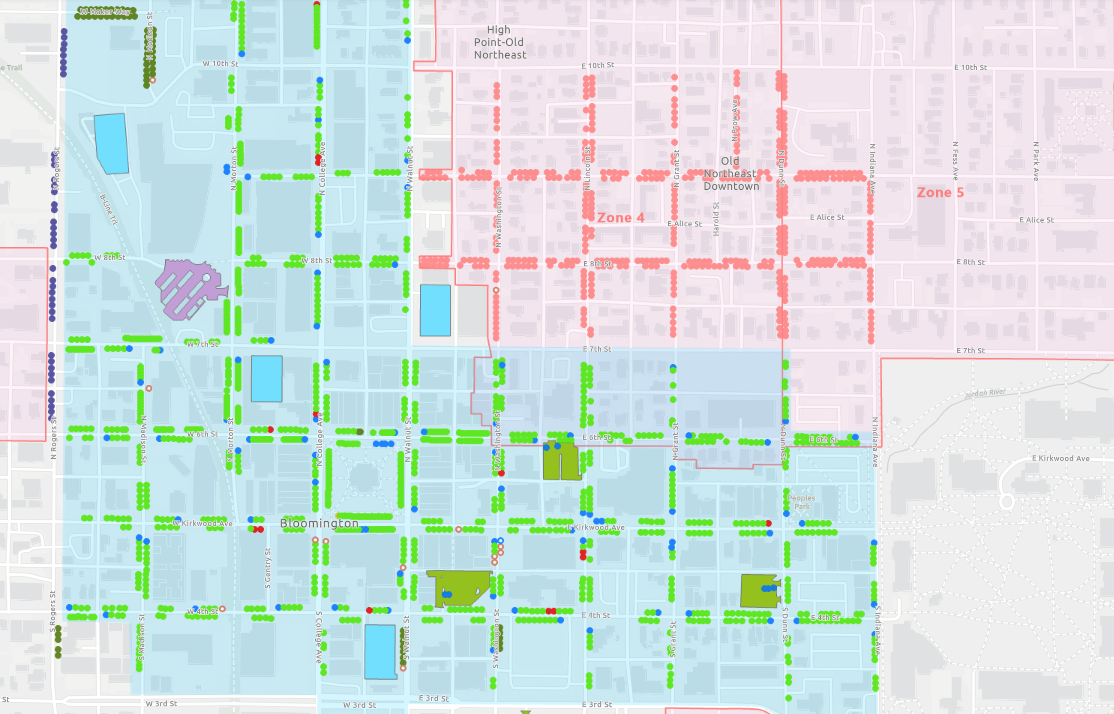
Ordinance 2025-02 was passed by City Council on January 22, 2025. The Board of Public Works passed the 2026 guidelines via Resolution 2026-006, which for 2026 leaves all the blocks of Kirkwood Avenue open to automobiles and allows implementation of parklets only. Businesses in the area in blue below are eligible for the Parklet Program. The full Parking Services Map may be accessed here.
2026 Season Timeline
- Application opens: Feb. 27, 2026
- Deadline for submitting applications: Mar. 13, 2026
- Implementation of program (weather permitting): Apr. 6–Apr. 9, 2026
- Season officially begins: Apr. 9, 2026
- End of seasonal outdoor dining program:Nov. 9, 2026
Parklet Eligibility
Eligibility is limited to food service establishments adjacent to metered parking in downtown Bloomington.
- City staff will review the proposed parklets' street locations to ensure they are suitable for the program.
- All participating businesses must agree to cease alcohol sales in parklets by midnight.
- Eligible businesses must complete the application and payment process as outlined in the guidelines below.
Parklet Guidelines
- Businesses are responsible for any direct costs associated with using a parklet.
- Each participating business must submit a certificate of insurance to the Economic and Sustainable Development Department establishing proof of a comprehensive general liability policy naming the City of Bloomington as additional insured to the extent of at least the following which shall be in effect during the term of this authorization:
- $1,000,000 each occurrence
- $1,000,000 personal injury and advertising injury
- $2,000,000 products and completed operations aggregate
- $2,000,000 general aggregate
- Cost to businesses will be $250 per parking space. A two-space parklet will cost $500, 3 spaces will cost $750.
- Businesses that share a parklet may split the cost. However, it is up to businesses to determine how to split the costs. Furthermore, both businesses will be required to provide a certificate of insurance for the required amounts.
Parklet Logistics
Eligibility:
- Eligibility is limited to food service establishments adjacent to metered parking in downtown Bloomington.
- City staff will review the proposed parklets' street locations to ensure they are suitable for the program.
- All participating businesses must agree to cease alcohol sales in parklets by midnight.
- Eligible businesses must complete the application and payment process as outlined in this memo.
- Previously approved parklet plans and implementations do not guarantee approval for the 2026 season.
Application Process:
- Application form will go live on the City’s webpage on February 27, 2026.
- Applications are due by March 13, 2026. Businesses may submit applications in advance of the deadline.
- A detailed site plan drawn to scale shall be submitted with the application. This site shall indicate the location of any platforms and seating installed in the parklet as well as any street furniture/trees. Measurements should be included to show conformance with Exhibit B.
- Fees are payable via the parklet application site by March 20, 2026.
Parklet Implementation:
- The participating businesses will work with City staff to install and remove parklets at the beginning and end of the 2026 season. Implementation will be coordinated by City staff.
- City staff will fill jersey barriers with water on the installation day.Participating businesses will be required to top off the barriers with water as needed, and the barriers must remain sufficiently full for safety purposes. City staff will continue researching alternatives to orange jersey barriers and will communicate directly with businesses if an alternate solution is to be installed.
- If the weather on April 6, 2026, is not conducive to outdoor dining, City staff may exercise discretion on the exact dates the parklets are installed.
Kirkwood Implications:
- Kirkwood will remain open to vehicular traffic (unless authorized by other City or state policy or practice, such as a Special Event in the Public Right of Way, construction, utility maintenance, etc.).
- Eligible Kirkwood businesses may participate in the Parklet Program.
Requirements for Participating Businesses:
- Participating businesses are required to provide their own furniture, decorations, platforms, etc.
- Participating businesses are required to invest in the beautification of parklet spaces through decor that meets safety standards (see Exhibit C).
- Participating businesses must meet all requirements for their extended outdoor seating, including the Americans with Disabilities Act (ADA), Indiana Alcohol Tobacco Commission (ATC), Monroe County Health Department, safety, and insurance requirements.
- Participating businesses must meet ADA/Accessibility requirements as stated in Exhibit B.
- Participating businesses must meet all Monroe County Building Department requirements and permits for their extended outdoor spaces.
- Decks/platforms must be flush with the adjacent curb.
- Decks/platforms, furniture, or anything else in spaces cannot block any building exits and must be designed to keep buildings in compliance with codes.
- Any decks or platforms constructed shall allow for adequate drainage through the gutter and not block any drainage inlets.
- Any decks or platforms constructed shall be easily removable in the event of an emergency.
- Parklet structures cannot block access to Fire Department Connections (FDCs) or Post Indicator Valves (PIVs).
- Tents and heaters are not allowed for use in the Outdoor Dining Program.
- Participating businesses must comply with Indiana Fire Code regulations.
- Businesses must remove all seating, furniture, decorations, and any other property from the parklet before the end of the program on November 9, 2026, when the parklet setups are set to come down or face fines in accordance with Title 12 of the Bloomington Municipal Code.
Discontinuance and/or Removal:
- Failure to comply with or maintain compliance with requirements for participating businesses may result in removal of the parklet.
- The City of Bloomington Public Works director, in consultation with the Director of Engineering, may decide to discontinue or remove all or certain parklets, at any time and for any reason.
- In the event discontinuance or removal occurs for either of the above-stated reasons, the City shall provide each affected participating parklet entity with five-days notice.
- If the parklet is removed by the City for reasons not related to Participant’s compliance, then the parklet may be reinstalled in the same calendar year, at the City’s discretion and expense. If the parklet is removed for Participant’s failure to comply with requirements, then the parklet may not be reinstalled in the same calendar year.
- All fees paid by the participating businesses are not subject to refunds, regardless of when the parklet is removed, or why it is removed. This is because the majority of costs to the City are up-front costs related to installation of barriers and compliance review and inspection.
- Any property owned by the parklet participants left in the parklet space at the end of the five days shall be removed by the City and placed in storage for thirty days, at no cost to the parklet participant. The City shall provide information to the participant regarding how and where they may retrieve their items. At the end of the thirty days, the items may be disposed of as the City deems fit.
Exhibit B: ADA/Accessibility Requirements:
Parklets must conform to the Americans with Disabilities Act (ADA) guidelines and Public Right-of-Way Accessibility Guidelines (PROWAG), or have adjacent outdoor seating options which conform to the ADA and PROWAG (if applicable). It is the responsibility of the applicant to design and implement their parklet seating to be compliant. Below are guidelines that will help design your space to be compliant with the ADA, PROWAG, and the City of Bloomington’s standards. The guidelines below are not expected to cover all contingencies, but rather to provide basic information that participants must adhere to.
Flush Platforms for Curb Access:
- A platform flush with the curb shall be constructed. This allows easy access for all users without having to worry about slope or tripping hazards.
- Platform Surface:
- Shall have a smooth, non-slip surface.
- Gaps shall be no greater than ½ inch wide.
- Platforms can be up to and under 30 inches in height.
If any portion of the decks/platforms exceed the maximum height requirement of 30 inches, construction design must be approved by the appropriate State and County building departments and a permit must be issued.
- If a flush platform cannot be constructed, due to site constraints, a raised deck may be substituted at the discretion of the Monroe County Building Inspector and City of Bloomington Community and Family Resources Special Projects Coordinator who oversees accessibility.
- Ramps to Deck Surface:
- Width: The width of a ramp shall be no less than 48 inches wide.
- Rise: The rise for any run shall be 30 inches maximum
- Handrails: Ramps with a rise greater than 6 inches shall have handrails between 34 to 38 inches vertically above the walking surface. The handrails shall extend 12 inches beyond both the top and bottom of the ramp.
- Edge Protection: Ramps shall have edge protection a minimum of 4 inches above the ramp surface.
- Landings: The landing clear width shall be at least as wide as the ramp. The landing clear length shall be a minimum of 60 inches long. Ramps
that change direction at the landing shall have a clear space a minimum of 60 x 60 inches.
- Decks/platforms, furniture, or anything else in spaces cannot block any building exits and must be designed to keep buildings in compliance with codes.
- Any decks or platforms constructed shall allow for adequate drainage through the gutter and not block any drainage inlets.
- Any decks or platforms constructed shall be easily removable in the event of an emergency.
- Platforms or structures cannot block access to Fire Department Connections (FDCs) or Post Indicator Valves (PIVs).
- Further information can be found in the 2010 ADA Standards for Accessible Design:
- Section 302 Floor or Ground Surfaces
- Section 405 Ramps
- Section 505 Handrails
Accessible Seating:
While it is encouraged that all seating be wheelchair accessible, it shall be required that a minimum of at least 1 seat for every 25 to remain accessible. Seating can be made accessible by following the guidelines below:
If only one accessible table is provided, it shall be placed closest to the accessible route into the parklet.
- Table Height: The table shall be 28-34 inches from the ground to the underside of the table.
- Knee Space: There shall be at least 27 inches of vertical knee space from the underside of the table, and at least 30 inches wide.
- Clearance: There shall be a clear floor space of at least 30 by 48 inches around the accessible seating.
- Availability: Accessible seating shall be available without necessitating the moving/removal of furniture.
- Comparable Amenities: Accessible seating shall share all of the same amenities as non-accessible seating.
- Further information can be found in the 2010 ADA Standards for Accessible Design: Section 221Assembly Areas
Section 306 Knee and Toe Clearance
Section 902 Dining Surfaces and Work Surfaces
Further information can be found in the PROWAG: o Section R405 Knee and Toe Clearance
Exhibit C: Beautification Guidelines
Several options are available to outdoor dining program participants for beautification. Examples of parklet + block beautification may include, but are not limited to, the adornment of art, accessibility alterations, or cosmetic improvements, all per guidelines listed in this “Exhibit C: Beautification Guidelines.” Given the potential costs for professional parklet beautification, employing cost-friendly and easy-to-implement solutions is crucial, as businesses will bear the costs. Businesses should work with City staff to determine appropriate beautification options for the spaces. No permanent physical changes can be made to the streetscape.
Beautification Options:
- Additional seating platforms
- Outside of their uses associated with outdoor dining, spaces installations may include wooden or metal benches, platforms, ramps, or additional forms of seating to compensate for increased customer capacity and general community interactions.
- Adornment of art
- Program participants are encouraged to use a variety of art sources to beautify spaces such as a collaboration with local artists and the utilization of murals.
- Space greenery
- Additional lighting
- Please review the Bloomington Municipal Code section 20.04.090 for compliance.
- Further cosmetic and logistical improvements
- More options for cosmetic improvements include the use of budget-friendly space dividers, outdoor rugs/flooring, temporary installations of menu/special boards, spaces dedicated for bike parking, and the inclusion of interactive features.