
Page last updated on September 22, 2026 at 12:50 pm
A Certificate of Appropriateness is required to make any external change to a protected structure in a Local Historic District and to move, demolish or build a new building in a Conservation District.
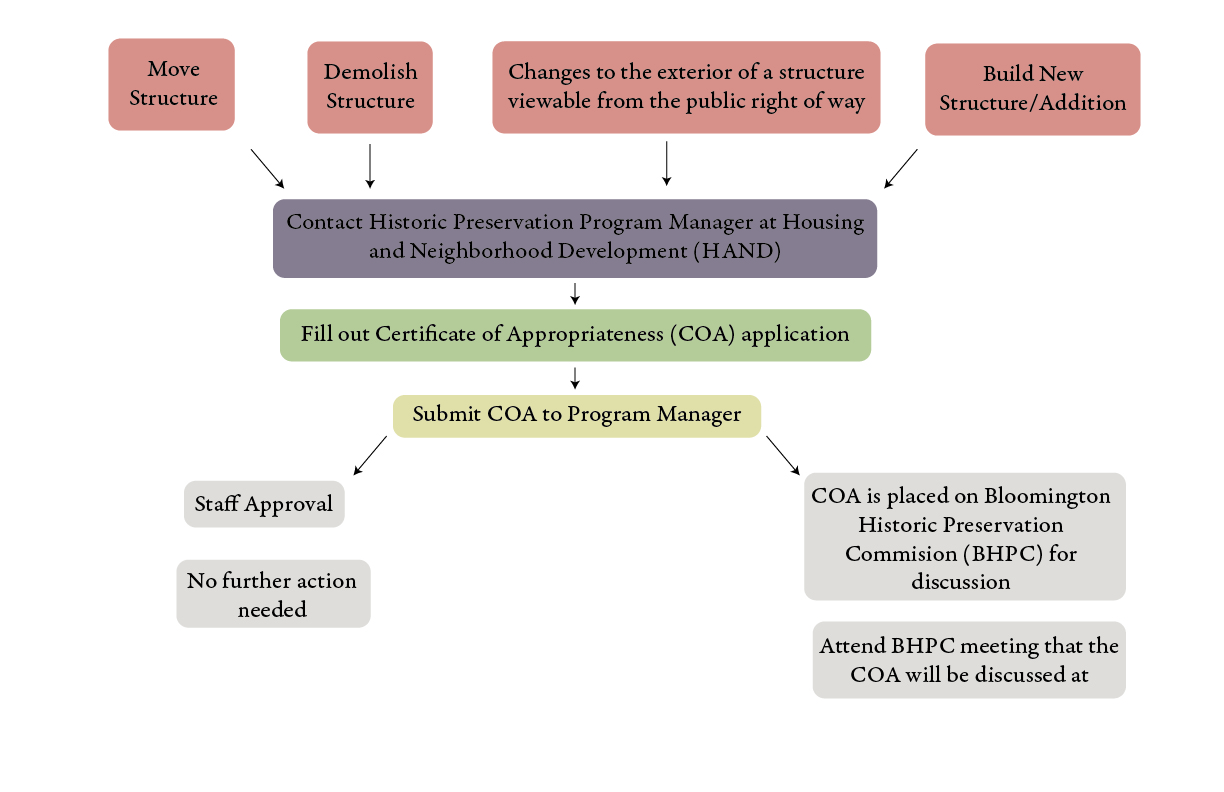
How do I apply for a Certificate of Appropriateness (COA)?
If a property is located in one of the districts on the Historic Districts Map, it is subject to review by the Historic Preservation Commission through the Certificate of Appropriateness process. You can find the additional information about the historic and conservation districts, maps, and guidelines at Local Historic Districts.
For any questions regarding historic properties or local designations, please contact Noah Sandweiss, the Historic Preservation Program Manager for the City of Bloomington, at (812) 349-3507 or [email protected].
INSTRUCTIONS TO PETITIONERS
- No fee is required for submission.
- The petitioner must attend a preliminary meeting with staff of the Department of Housing and Neighborhood Development during which the petitioner will be advised as to the appropriateness of the request and the process of obtaining a Certificate of Appropriateness. This can be done in person, via the phone, or teleconference.
- Application for the Certificate of Appropriateness: The Bloomington Historic Preservation Map provides the historic district and historic building survey. You need to open the layers and click on “Historic Sites and Survey” to find the historic ratings which are color coded.
- Communicate with the Monroe County Building Department and the City of Bloomington’s Planning and Transportation Department in order to verify if there are additional requirements.
- In the historic districts listed on the bottom of the page, the petitioner should contact the historic district construction subcommittee and acquire their feedback as early in the process as possible.
- The petitioner must file a complete application that includes all of the required documents with Housing and Neighborhood Department Staff no later than twelve days before a scheduled regular meeting.
CHECKLIST OF REQUIRED DOCUMENTS
- Filled and signed Application for the Certificate of Appropriateness
- Written description of the nature of the proposal.
- Written description of all of the proposed materials to be used.
- Between 3 and 5 photographs of the historic site and/or structure before changes.
- Scaled drawings or sketches, manufacturer’s brochures, and/or photographic precedents showing the proposed alterations to the exterior, additions, changes, or new construction. A grid with tips on how to use it has been made available to facilitate drawing (All images must be clear and submitted either in a physical format or as 150-300 dpi jpg, png, or pdf.).
- A map of the site with the site boundaries indicated (GIS imagery from sites such as the Elevate tax maps available at (https://monroein.elevatemaps.io/ or Google Maps (maps.google.com) are acceptable).
- In the case that the historic district in which the property is located has a construction subcommittee, it is highly advisable to contact and review your project with said committee before submitting the application. Contact information for the committee representatives is available upon request from the Historic Preservation Program Manager.
Where do I go?
The petitioner, owner or a delegated representative must attend the Bloomington Historic Preservation Commission (BHPC) Meeting. The BHPC meets the second and fourth Thursday of each month at 5:00 P.M. in a hybrid fashion, at the McCloskey Room (401 N Morton St., Room 135) and via Zoom (with a link to be provided). The petitioner will be notified of the Commission’s decision and a Certificate of Appropriateness will be issued to them. Copies of the Certificate must accompany any building permit application subsequently filed for the work described. If the petitioner feels uncertain of the merits of the petition, they also have the right to attend a preliminary hearing, which will allow you to discuss the proposal with the Commission before the hearing during which action is taken. Action on a filing must occur within thirty days of the filing date, unless a preliminary hearing is requested.
Historic Commission meetings are scheduled the second and fourth Thursday of every month and are held in the McCloskey Room (135) of Showers City Hall at 5 PM. You or your representative should plan to appear to answer questions.
Meetings are currently being held via Zoom. The link can be found on the City Calendar under Bloomington Historic Preservation Commission on the scheduled meeting dates.
Please follow the link below to view the 2026 schedule of Historic Preservation Commission meetings:
What is the Commission Review Process?
When property owners submit Certificates of Appropriateness (COA) and Demolition Delays (DD) for properties within the City of Bloomington, historic preservation staff and commissioners adhere to the following procedures.
- Once a petitioner submits a COA or DD to the city's Historic Preservation Manager, staff will add that item to the Historic Preservation Commission's agenda for an upcoming meeting. For COA's, staff will determine if it will be reviewed by staff or by the commission. All DD's must be reviewed by the commission. All COA's will be heard before DD's.
- Staff reviewed COA's will be handled before COA’s that require commission review. Staff will describe the request and report their decision to approve, deny, or continue the petition. Should the petitioner disagree with the staff finding, they are welcome to request a full commission review.
- All COA’s and DD’s reviewed by the commission will be handled as follows:
- STAFF REPORT
Staff present their report on the petition. This report will include materials from the petition and additional research that staff conducts. Staff will include a recommendation in their report regarding the commission's action on the petition. - PETITIONER COMMENTS
Following the report, the meeting’s chair will call upon the petitioner and ask if they want to comment on the petition. - PUBLIC COMMENT
The chair will ask the public if they wish to comment on the petition. - COMMISSIONER QUESTIONS
Once public comment is completed, each commissioner may ask questions to staff, the petitioner, and other relevant parties. These questions are intended to help clarify information detailed in the petition. - MOTION:
After questions are completed, the chair will ask commissioners for a motion on the petition. Motions can be made to approve, deny, or continue the petition. A motion must be seconded by another commissioner in order for it to proceed. - COMMISSIONER COMMENTS:
With a motion seconded, commissioners will offer comments on the petition. - VOTE:
The chair will call for a vote. A majority of commissioners present for the meeting are needed for the motion to pass.
- STAFF REPORT
FOLLOW UP:
The city's historic preservation officer will follow up after the meeting with either approved paperwork or detail next steps should the petition be denied or continued to the next meeting.
What do I receive if my COA application is approved?
A Certificate of Appropriateness is much like a building permit. It should be displayed in your window while work is in progress. If your work also requires a building permit from the Monroe County Building Department, the COA should be attached to that application.